
More fuel for algae
Excess phosphorus can accelerate eutrophication—the enrichment of water that supports excessive algae and cyanobacteria. Some cyanobacterial blooms can produce toxins.
Science & research
Cascade Aquatics is built around a mass-balance question: where is phosphorus entering, recycling within, and leaving the lake—and can an engineered export pathway materially improve that balance?
The phosphorus problem
Phosphorus is a key driver of eutrophication in many freshwater lakes because it is often the nutrient that limits algal growth.
When excess phosphorus becomes available, it can support more algae and cyanobacteria. The resulting growth, shading, decay, and oxygen demand can alter habitat and recreation—even though phosphorus is not the only factor controlling every bloom.
Excess phosphorus can accelerate eutrophication—the enrichment of water that supports excessive algae and cyanobacteria. Some cyanobacterial blooms can produce toxins.
Dense growth can reduce water clarity and shade underwater plants that provide food and habitat.
When algae and plants die, decomposition consumes oxygen. Low oxygen can stress fish and other aquatic life, especially in deeper water.
In some lakes, low-oxygen conditions favor phosphorus release from bottom sediments, making stored phosphorus available again.
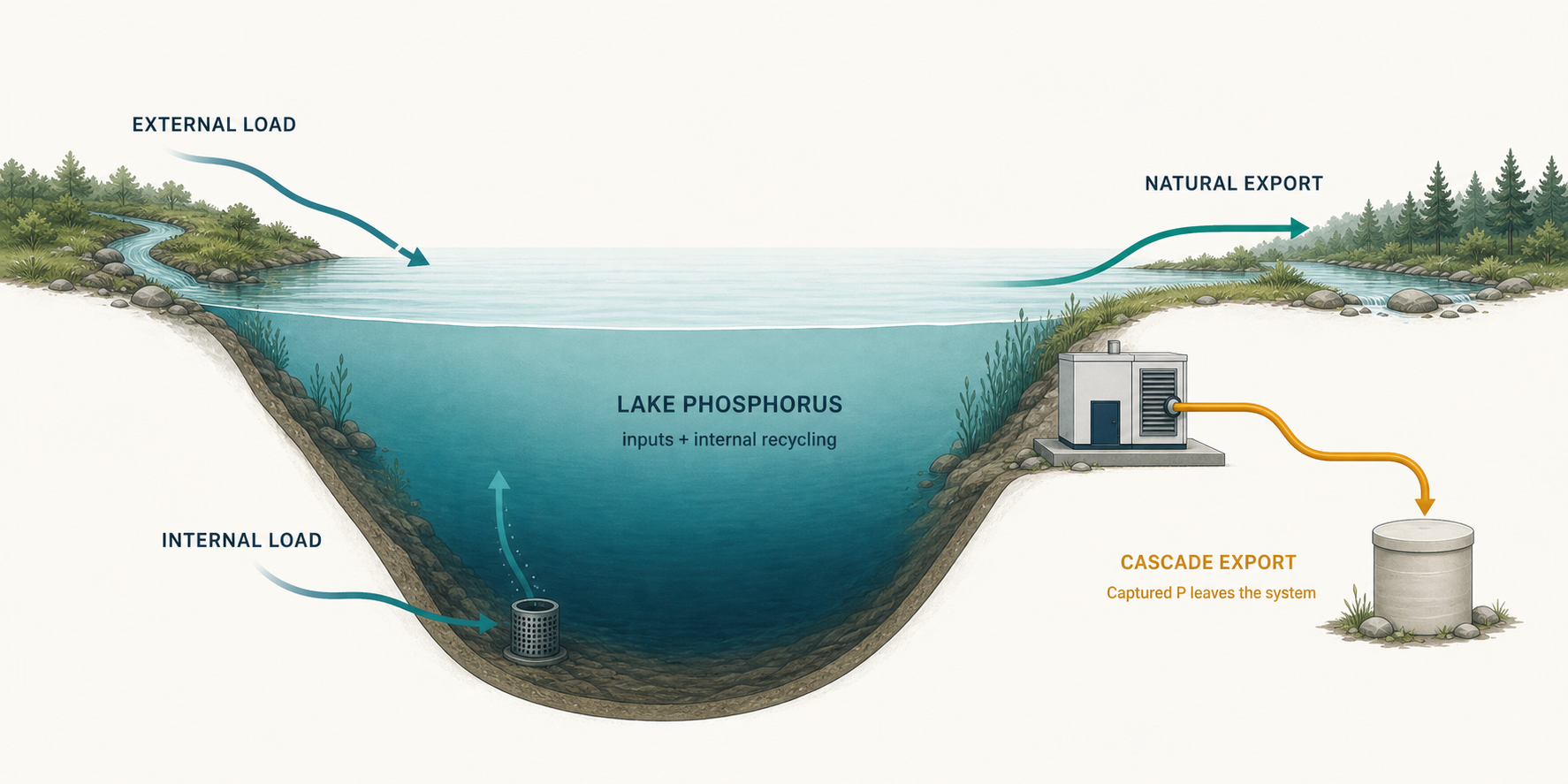
The recycling mechanism
A lake can receive phosphorus today from material that entered years or decades ago.
In some stratified lakes, bottom water becomes oxygen-poor during part of the year. Under the right chemical conditions, sediments can release stored phosphorus back into the water. Seasonal mixing or other transport can then make that phosphorus available to support new growth.
Phosphorus delivered over many years can become stored in bottom sediments.
Seasonal stratification can isolate deeper water, where decomposition gradually consumes dissolved oxygen.
Under the right chemical conditions, sediment-bound phosphorus can move back into the water.
Seasonal circulation and other transport can make recycled phosphorus available to support new growth.
Internal loading does not make external-load control optional. A credible restoration strategy must address ongoing inputs and determine whether the internal store is large enough to require an additional pathway.
Mass flow
A treatment system removes more phosphorus when it treats water with a higher phosphorus concentration, all else equal.
Hypolimnetic water, sediment-interface water, inflows, and high-load events may therefore be better targets than ordinary surface water. Concentration before separation avoids trying to process an entire lake indiscriminately.
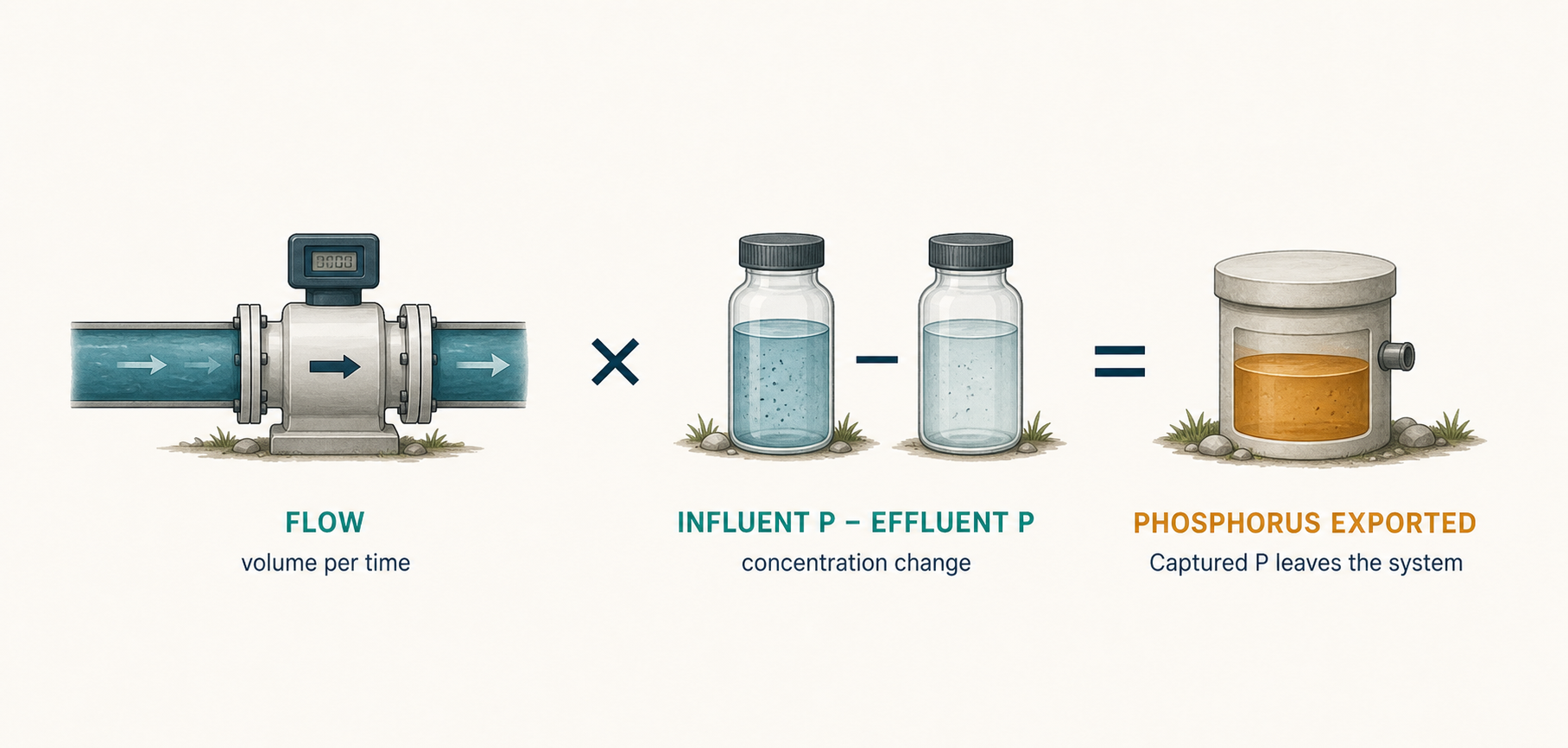
From capture to export
Treatment must do more than lower phosphorus in one stream. The captured phosphorus must be concentrated into a separable material, moved out of the aquatic system, and measured as mass exported.
Identify deep water, sediment-interface water, inflows, or events where more phosphorus can be reached per gallon treated.
Move phosphorus from the water into a controllable solid, media, or treatment residual.
Physically move the phosphorus-bearing residual out of the aquatic system instead of returning it with the water.
Pair flow with influent and effluent phosphorus concentrations to calculate exported mass and track lake response.
Published field evidence
These published results demonstrate technical plausibility—not guaranteed Cascade performance, Midwest economics, or universal lake applicability.
Restoration toolbox
Cascade Aquatics does not argue that phosphorus inactivation is ineffective. Long-term alum treatments can produce substantial and durable water-quality improvements.
Cascade is investigating when physical export may provide an attractive additional or alternative pathway.
Start with the lake
Tell us what is happening, what data you have, and what your community is trying to restore.